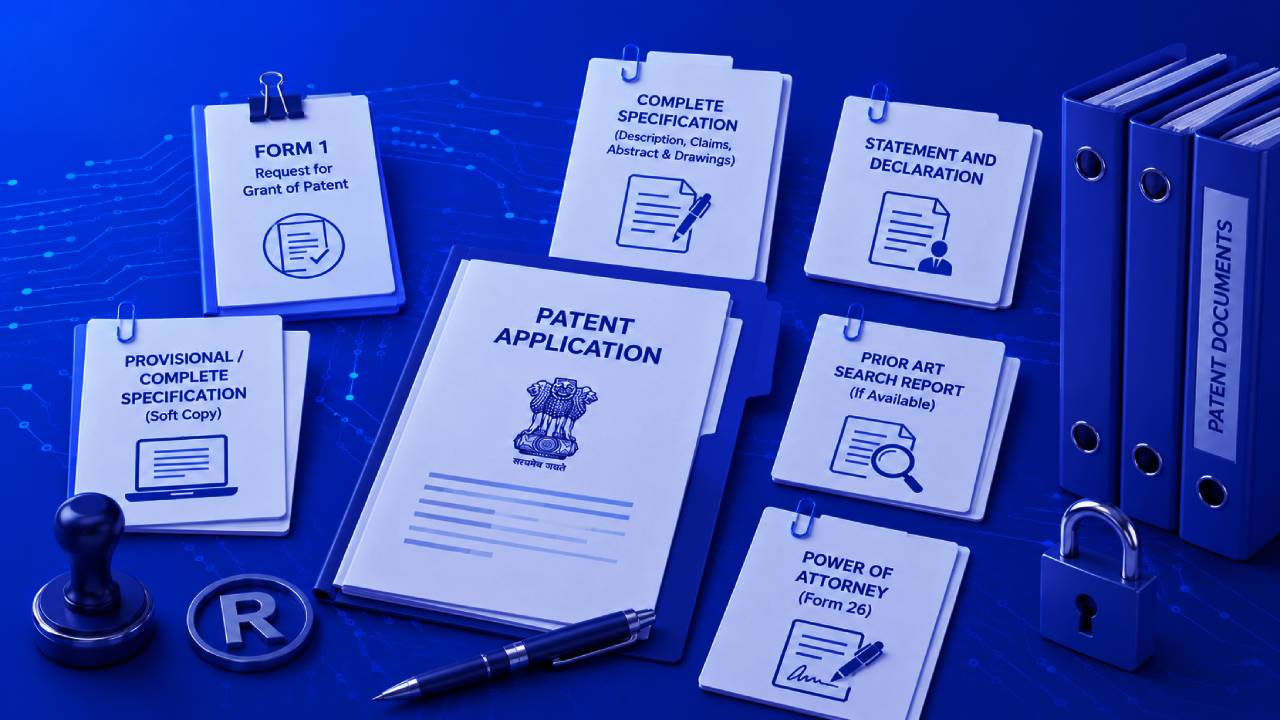
Filing a patent is one of the most important steps for protecting an invention in India. Whether the applicant is an individual inventor, startup, research institution, or company, preparing the correct paperwork is essential for a smooth filing process. Many applicants search for information regarding the documents for patent filing in India because incomplete or incorrect documentation often leads to delays, objections, or abandonment of applications.
The Indian patent system follows strict procedural requirements under the Patents Act, 1970 and the Patent Rules, 2003. Every patent application must include specific forms, declarations, technical specifications, and supporting documents. Understanding these requirements before filing helps applicants save time and avoid procedural complications.
This article explains the essential documents needed for patent filing in India, their purpose, and the practical considerations applicants should keep in mind.
Understanding the Patent Filing Process in India
Patent applications in India are administered by the Office of the Controller General of Patents, Designs and Trade Marks. The official filing procedures, forms, and fee schedules are available on the Indian Patent Office portal. A patent protects inventions which are novel, involve an inventive step, and are capable of industrial application. The filing process begins with preparing technical and legal documentation describing the invention in detail. The quality and accuracy of documentation directly affect examination and grant timelines. Even technically strong inventions may face delays if filing requirements are not fulfilled properly.
Documents for Patent Filing in India
Applicants must prepare various legal and technical documents before submitting a patent application. The exact documentation may vary depending on whether the applicant is filing a provisional application, complete specification, convention application, or Patent Cooperation Treaty application.
1. Patent Application Form
The primary document is Form 1, which contains basic details regarding the applicant, inventor, title of invention, and filing category. This form also specifies whether the applicant is an individual, startup, small entity, or large organisation. Fee structures vary according to applicant category. Incorrect details in Form 1 may create procedural complications later. Applicants should ensure consistency in names, addresses, and ownership information.
2. Provisional or Complete Specification
The patent specification is the most important technical document in the filing process. It explains the invention comprehensively and defines the scope of protection sought. Applicants may initially file a provisional specification if the invention is still under development. A complete specification must then be filed within twelve months. A complete specification generally includes the following:
- Title of the invention
- Field of invention
- Background and prior art
- Objects of the invention
- Detailed description
- Drawings and diagrams, if required
- Claims defining legal protection
- Abstract of the invention
The drafting quality of the specification plays a major role during examination. Ambiguous or poorly drafted claims often lead to objections. Inventors frequently consult top rated patent attorneys in India for drafting assistance because technical accuracy and legal precision are equally important in patent specifications.
3. Statement and Undertaking Under Form 3
Form 3 relates to foreign patent applications corresponding to the same invention. Applicants must disclose details of foreign filings and undertake to keep the Patent Office informed regarding subsequent developments in those applications. This requirement promotes transparency and enables the Indian Patent Office to examine related international applications where necessary.
4. Declaration of Inventorship
Form 5 contains the declaration of inventorship and identifies the true inventors of the invention. This document becomes mandatory when filing a complete specification. It confirms the identity of inventors and helps establish ownership rights. Errors in inventorship details can create disputes regarding patent ownership and validity.
5. Power of Authority
Where a patent agent or attorney files the application on behalf of the applicant, a Power of Authority or authorisation document may be required. The authorisation enables the patent professional to communicate with the Patent Office, file responses, and attend hearings on behalf of the applicant. The applicable procedural rules are available through the Patent Rules, 2003.
6. Proof of Right
If the applicant is not the inventor, proof supporting the applicant’s right to file the application must be submitted. This document may include assignment deeds, employment agreements, or invention transfer agreements. For example, when an employee develops an invention during employment, the employer company may become the applicant based on contractual arrangements.
7. Priority Documents
Priority documents become necessary when claiming priority from an earlier foreign application under the Paris Convention or the Patent Cooperation Treaty. These documents establish the earlier filing date and preserve priority rights across jurisdictions. Certified copies of earlier applications may need to be submitted within prescribed timelines.
8. Sequence Listing
For biotechnology related inventions involving nucleotide or amino acid sequences, sequence listings may be required in prescribed electronic formats. Failure to provide sequence listings correctly can result in examination objections.
9. Startup or Small Entity Certificate
Applicants claiming startup or small entity status must provide supporting documents. Recognised startups may submit certificates issued by the Department for Promotion of Industry and Internal Trade. Small entities may provide financial documents or declarations demonstrating eligibility. Fee benefits and expedited examination options may depend on these classifications.
Importance of Accurate Patent Documentation
Patent filing is not merely an administrative exercise. Every document carries legal significance and influences the enforceability of future patent rights. Incomplete disclosures, inconsistent inventor details, or vague claims may weaken protection even after grant. Accurate documentation also reduces examination objections and improves procedural efficiency. Applicants should carefully review all filings before submission to ensure compliance with statutory requirements.
Additional Documents Required in Certain Cases
Some applications require additional supporting records depending on the nature of the invention or filing route.
1. Biological Material Authorisation
Where biological materials are involved, applicants may need approval from relevant authorities and deposit information from recognised depositories.
2. Form 28 for Startups and Small Entities
Applicants claiming concessional fees as startups or small entities must submit Form 28 along with supporting evidence. Incorrect classification may result in objections or fee deficiencies.
3. International Patent Cooperation Treaty Documents
For Patent Cooperation Treaty national phase applications, applicants must submit international publication details, translations where necessary, and related filing documents. Guidelines regarding international filings are available through the World Intellectual Property Organization Patent Cooperation Treaty portal.
Common Mistakes While Preparing Patent Filing Documents
Many patent applications face delays because applicants overlook procedural details. One common mistake involves filing incomplete specifications with insufficient technical disclosure. Another frequent issue arises from incorrect applicant or inventor details. Applicants also sometimes fail to submit foreign filing information under Form 3 or miss deadlines for filing complete specifications after provisional applications. Improper claim drafting is another significant concern. Claims define the legal scope of protection, and poorly structured claims may limit enforceability. Businesses seeking strategic patent protection often consult best ip firms in india for comprehensive filing support, prosecution strategy, and portfolio management.
Difference Between Provisional and Complete Specification
Understanding the distinction between provisional and complete specifications is important for applicants planning their filing strategy. A provisional specification secures an early filing date while allowing additional time for research and development. It generally contains a broad description of the invention without final claims. A complete specification provides detailed disclosure and legally enforceable claims. Without filing the complete specification within twelve months, the provisional application lapses. Applicants should evaluate commercial readiness and technical development before deciding which route to adopt.
Importance of Patent Drawings and Technical Illustrations
Technical drawings often form an important part of patent applications, especially for mechanical, engineering, and product inventions.Drawings help explain structural features and improve understanding of the invention during examination. Patent drawings must follow prescribed formatting standards regarding margins, numbering, labels, and clarity. Well prepared illustrations strengthen technical disclosure and reduce ambiguity.
Digital Filing of Patent Applications in India
India now permits electronic filing of patent applications through the official Patent Office portal. Online filing has improved efficiency and accessibility for applicants across the country. Electronic filing also enables applicants to track application status, examination reports, and hearing notices digitally. Applicants should ensure scanned documents are legible and uploaded in prescribed formats to avoid technical defects. The e filing portal of the Indian Patent Office provides detailed guidance regarding online filing procedures.
Why Professional Assistance Matters in Patent Filing
Patent law combines technical complexity with procedural precision. Preparing specifications, claims, and statutory forms requires both legal and scientific understanding. Professional guidance helps applicants avoid drafting weaknesses and procedural errors. Patent professionals also assist during examination, hearings, oppositions, and enforcement proceedings. Strong documentation at the filing stage creates a solid foundation for future protection and commercialisation.
Conclusion
Preparing the correct documents for patent filing in India is essential for securing effective legal protection over an invention. Every stage of the filing process involves specific technical and procedural requirements, ranging from specifications and declarations to authorisations and priority documents. Applicants should approach patent filing carefully because errors at the initial stage may create long term complications. Clear specifications, accurate inventor details, timely submissions, and procedural compliance improve the chances of successful patent grant. As innovation activity grows rapidly in India, understanding patent documentation requirements has become increasingly important for startups, inventors, research institutions, and businesses seeking intellectual property protection.
FREQUENTLY ASKED QUESTIONS (FAQS)
What are the main documents for patent filing in India?
The main documents include Form 1, provisional or complete specification, Form 3, Form 5, proof of right, and authorisation documents where applicable.
Is a provisional specification mandatory?
No. Applicants may directly file a complete specification if the invention is fully developed.
What is Form 3 in patent filing?
Form 3 is a statement and undertaking regarding corresponding foreign patent applications related to the same invention.
Can a patent application be filed online in India?
Yes. Patent applications can be filed electronically through the Indian Patent Office portal.