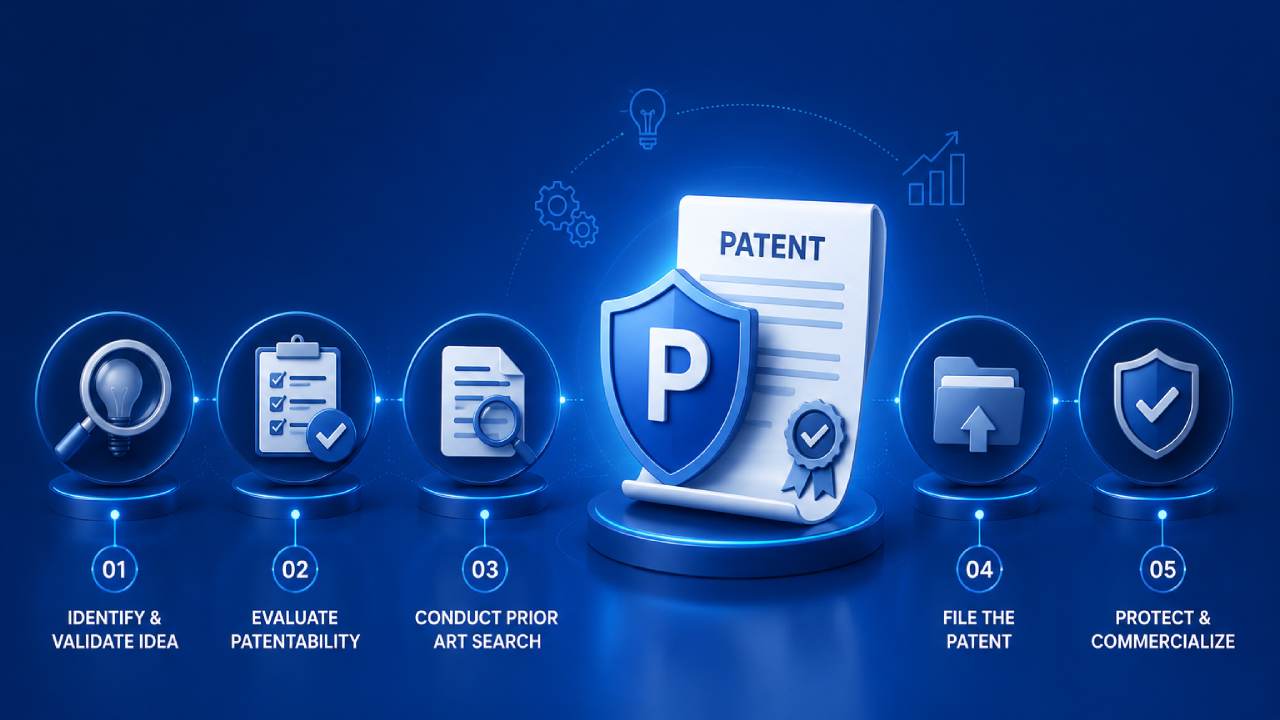
In today’s innovation driven economy, intellectual property has become one of the most valuable assets for emerging businesses. An effective IP Strategy Startups plan helps founders protect innovation, attract investors, secure market advantage, and strengthen long term business growth. For startups operating in technology, healthcare, software, manufacturing, artificial intelligence, and digital services, patent protection can significantly influence valuation and commercial success.
Many startups delay intellectual property planning until a product reaches the market. This often creates legal and commercial risks. Competitors may copy innovations, investors may question ownership rights, and public disclosures may weaken patent eligibility. A structured intellectual property strategy should begin at the earliest stage of business development. This article explains how startups should approach patent filing, when protection should begin, and the key legal considerations involved in building a strong intellectual property framework.
Understanding the Importance of Intellectual Property for Startups
Intellectual property refers to legally protected rights over inventions, creative works, technical solutions, branding elements, and confidential business information. For startups, intellectual property often represents the core commercial value of the business. A well structured intellectual property strategy can help startups:
- Protect innovative products and technologies
- Prevent unauthorised copying
- Improve investor confidence
- Create licensing opportunities
- Strengthen market positioning
- Increase acquisition value
For founders building scalable businesses, intellectual property protection is no longer optional. It is a strategic business necessity.
IP Strategy Startups: Why Early Planning Matters
A strong IP Strategy Startups approach begins before public launch or investor outreach. Many founders mistakenly assume patent protection starts only after filing an application. In reality, intellectual property strategy includes confidentiality management, ownership documentation, prior art research, and commercial planning long before formal filing. Delaying protection can create serious risks. Public disclosure before filing may destroy novelty requirements under patent law. Poorly drafted contracts may also create disputes regarding ownership of inventions developed by employees or consultants. Early planning helps startups build stronger legal foundations and avoid costly disputes later.
What Can Startups Patent?
Not every idea qualifies for patent protection. Patents generally protect inventions involving:
- New products
- Technical processes
- Manufacturing methods
- Software with technical effect
- Hardware innovations
- Industrial systems
- Medical technologies
To receive patent protection, an invention usually must satisfy three key conditions:
- Novelty
- Inventive step
- Industrial applicability
Business concepts, abstract ideas, mathematical methods, and discoveries without technical application generally do not qualify for patents.
When Should Startups File a Patent?
Timing plays a crucial role in patent strategy. Startups should ideally file a patent application before publicly disclosing technical details of the invention. Public disclosures may include:
- Product launches
- Investor presentations
- Online demonstrations
- Technical publications
- Trade exhibitions
India follows the “first to file” system. This means the first applicant usually receives priority rights, even if another inventor developed the idea earlier. Startups often begin with a provisional patent application. A provisional filing secures an early filing date while allowing additional time to refine the invention before submitting the complete specification. This approach helps startups preserve rights while continuing product development and market testing.
Importance of Confidentiality Before Filing
Confidentiality is essential before filing a patent application. Startups frequently discuss products with investors, employees, consultants, vendors, and development teams during early stages. Without proper safeguards, confidential information may leak into the public domain. Founders should use Non Disclosure Agreements when sharing sensitive technical details. Confidentiality agreements typically define:
- Scope of confidential information
- Permitted use of information
- Duration of obligations
- Legal remedies for breach
Strong confidentiality measures not only protect innovations but also strengthen future intellectual property claims.
Conducting a Patent Search Before Filing
A prior art search is one of the most important steps in patent strategy. Patent searches help startups determine whether similar technologies already exist. This reduces the risk of investing resources into weak or non patentable inventions. A proper search evaluates:
- Existing patents
- Published patent applications
- International databases
- Technical publications
- Industry disclosures
Patent searches also help identify competitor activity and potential infringement risks. Choosing Between Provisional and Complete Patent Applications Startups often face confusion regarding provisional and complete patent filings. A provisional patent application is suitable when the invention is still under development but early protection is necessary. It secures a priority filing date and provides time for further technical refinement. A complete specification contains detailed technical descriptions, claims, and supporting information required for examination. For many startups, provisional applications provide practical advantages during early stage development and fundraising discussions. However, provisional applications must still describe the invention adequately. Weak disclosures may affect future protection.
Patent Filing and Investor Confidence
Investors increasingly evaluate intellectual property portfolios before funding startups. A pending or granted patent demonstrates innovation, scalability, and commercial potential. Intellectual property assets may also improve company valuation during mergers, acquisitions, and strategic partnerships. Technology focused startups with structured patent strategies often gain stronger negotiating positions during investment discussions. Many founders seek support from a patent law firm for legal support to ensure patent portfolios align with commercial and fundraising goals.
International Patent Strategy for Startups
Modern startups frequently target international markets from an early stage. Patent rights, however, are territorial. A patent granted in India does not automatically provide protection in other countries. International patent strategy depends on several factors:
- Target markets
- Manufacturing locations
- Competitor activity
- Budget considerations
- Licensing plans
Strategic international filings can help startups preserve rights across multiple jurisdictions while managing costs effectively.
Protecting Intellectual Property Beyond Patents
Patents form only one part of a broader intellectual property strategy. Startups should also consider:
- Trademark protection for branding
- Copyright protection for creative works
- Trade secret protection for confidential information
- Domain name security
- Licensing agreements
For example, software source code structures, pricing algorithms, customer databases, and operational methods may sometimes be better protected as trade secrets rather than patents. Businesses often work with intellectual property lawyers for businesses to create integrated intellectual property protection frameworks covering patents, trademarks, copyrights, and confidential information.
Common Patent Filing Mistakes Startups Should Avoid
Many startups weaken their intellectual property rights through avoidable mistakes. Common errors include:
- Public disclosure before filing
- Poorly drafted patent applications
- Failure to document invention development
- Ignoring ownership clauses in employment agreements
- Delayed filing decisions
- Lack of international protection planning
Patent drafting requires both legal and technical precision. Weak claims may reduce enforceability and commercial value. Early legal guidance can significantly improve long term protection outcomes.
Government Support for Startup Patent Filing in India
India has introduced several initiatives supporting startup innovation and intellectual property protection. Eligible startups recognised under the Startup India Initiative may receive benefits including:
- Reduced patent filing fees
- Fast track examination
- Intellectual property support programmes
- Facilitator assistance schemes
Government support has encouraged more startups to prioritise patent protection during early growth stages.
Building a Long Term Intellectual Property Strategy
An effective intellectual property strategy should evolve alongside the business. Startups should regularly review:
- Patent portfolio strength
- Competitor filings
- Market expansion plans
- Licensing opportunities
- Research and development pipelines
Intellectual property should align with broader business objectives rather than function merely as a legal formality. Businesses with structured intellectual property strategies often achieve stronger commercial sustainability and market differentiation.
Conclusion
Intellectual property protection plays a decisive role in modern startup growth. A well planned IP Strategy Startups framework helps businesses secure innovation, reduce legal risks, strengthen investor confidence, and create long term commercial value. Patent filing should not be treated as a last minute legal process. Founders must carefully manage confidentiality, ownership rights, timing, documentation, and international expansion considerations from the earliest stages. For startups operating in competitive markets, intellectual property is often the foundation of long term success. Strategic planning today can determine whether a startup becomes an industry leader or loses valuable innovation to competitors tomorrow.
FREQUENTLY ASKED QUESTIONS (FAQS)
What is IP Strategy Startups?
IP Strategy Startups refers to the process of identifying, protecting, managing, and commercialising intellectual property assets for startup businesses.
When should startups file a patent?
Startups should ideally file a patent application before publicly disclosing technical details of the invention.
What is a provisional patent application?
A provisional patent application secures an early filing date while allowing additional time to complete development before filing the complete specification.
Can software startups obtain patents in India?
Software related inventions may receive patent protection if they demonstrate technical effect or technical contribution beyond a computer program itself.