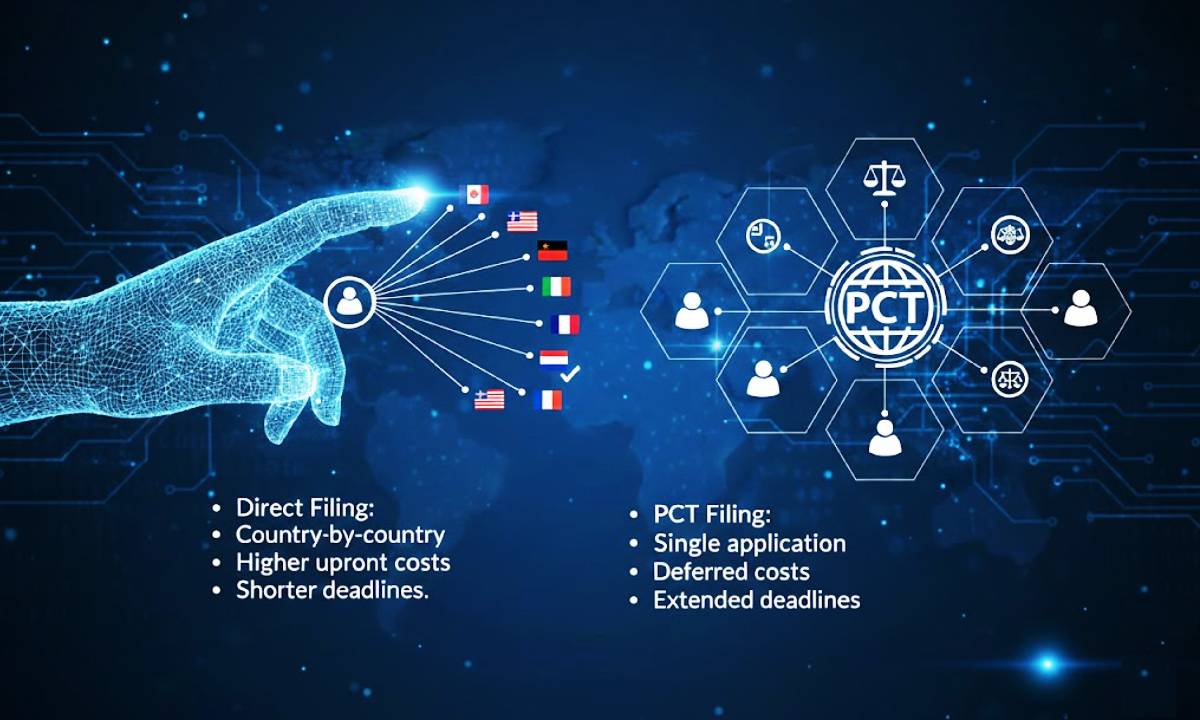
Innovators planning to protect their inventions beyond national borders often face an important strategic decision. They must choose between filing through the Patent Cooperation Treaty system or filing separate applications in individual countries. The debate around PCT vs Direct Foreign Patent Filing therefore becomes central to international intellectual property planning. Each approach offers distinct advantages, timelines, and cost structures.
Understanding PCT vs Direct Foreign Patent Filing helps inventors, start-ups, and technology companies decide how to expand patent protection across international markets. The choice affects filing strategy, legal costs, and the level of administrative complexity involved in obtaining global patents. While some applicants prefer the flexibility of the PCT system, others opt for direct filings in specific jurisdictions where commercial activity already exists.
This article explains the key differences between these two methods, examines practical considerations for inventors, and highlights how businesses can develop an effective international patent strategy.
Understanding International Patent Protection
Patent protection remains territorial. A patent granted in one country offers protection only within that jurisdiction. Inventors seeking protection in multiple markets must therefore file applications in each relevant country. International frameworks simplify this process but do not create a single global patent. Instead, they provide procedural pathways which allow applicants to pursue patent rights in several jurisdictions.
The Patent Cooperation Treaty represents one such framework. It is administered by the World Intellectual Property Organization and allows applicants to file a single international application before entering national patent offices.
Direct foreign filing represents the alternative route. Under this approach, applicants submit patent applications directly in the patent offices of selected countries within the required priority period. For Indian applicants, foreign filings often begin after a domestic application is submitted before the Indian Patent Office.
H2: PCT vs Direct Foreign Patent Filing
The comparison of PCT vs Direct Foreign Patent Filing focuses mainly on procedure, timelines, and cost management. Under the PCT system, an applicant files a single international patent application which later enters national patent offices after the international phase. This phase includes a prior art search and publication of the application.
Direct foreign patent filing involves submitting separate patent applications in each country where protection is required. Each filing proceeds independently under local patent laws. Both approaches ultimately lead to national examination and potential patent grants. However, the procedural journey differs significantly.
Filing Procedure and Administrative Structure
The PCT system centralises the early stage of international patent filing. Applicants submit one international application through a receiving office such as the Indian Patent Office. The application undergoes an international search which identifies relevant prior art and evaluates patentability. After publication, the application remains in the international phase before entering national jurisdictions.
Direct foreign filing requires immediate coordination with multiple patent offices. Applicants must prepare and submit separate applications in each country. Each jurisdiction may require different forms, translations, and legal representation. For many applicants, the PCT system simplifies administrative tasks during the initial stages of international patent protection.
Timeline Differences Between the Two Approaches
The PCT vs Direct Foreign Patent Filing comparison often highlights differences in filing timelines. The PCT system provides an extended timeframe for applicants. After the first filing, the international phase typically lasts up to thirty months before national phase entries become necessary.
This extended period allows inventors to evaluate commercial prospects and refine their patent strategy. Direct foreign filing follows the priority system established under the Paris Convention. Applicants must file foreign applications within twelve months from the original filing date. This shorter timeframe requires faster decision making regarding target markets and financial commitments.
Cost Structure and Financial Planning
Cost considerations influence the choice between the two systems. The PCT route involves international filing fees and search fees during the initial stage. However, national phase expenses arise later in the process. This structure spreads costs over a longer period.
Direct foreign filing may appear less expensive initially because there is no international phase. Yet applicants must pay filing fees and professional charges in each country within the twelve month priority period.
Companies planning a foreign patent application strategy often compare these cost structures carefully before choosing the appropriate approach. In many cases, the PCT system provides financial flexibility by delaying major national filing expenses.
Market Strategy and Business Planning
International patent protection must align with commercial goals. The decision between PCT filing and direct foreign filing depends largely on market strategy. Companies targeting several international markets often prefer the PCT route. The additional time allows them to evaluate commercial demand, secure investment funding, and analyse competitor activity.
Start-ups especially benefit from the extended timeline because early stage businesses frequently operate under financial constraints. Direct foreign filing may suit companies already operating in specific foreign markets. If commercial activity exists in one or two jurisdictions, immediate national filings may provide faster legal protection. Thus the strategic context plays a crucial role in the PCT vs Direct Foreign Patent Filing decision.
Patentability Assessment and Technical Evaluation
Another advantage of the PCT route lies in the international search report issued during the early stage of the process. The report identifies prior art relevant to the invention and provides an initial opinion regarding patentability. This assessment allows applicants to evaluate the strength of the application before entering national patent offices.
Inventors may revise claims or improve technical disclosures based on these findings. Direct foreign filings do not provide a centralised international search stage. Each patent office conducts examination independently. As a result, applicants receive patentability feedback separately from each jurisdiction. For technology companies seeking early technical insight, the PCT route often proves valuable.
Administrative Complexity in Global Patent Filing
Managing patent applications across multiple jurisdictions requires careful coordination. Direct foreign filing requires applicants to work with several local patent attorneys simultaneously. Each country may impose different procedural requirements, translation obligations, and official deadlines.
The PCT system reduces this complexity during the initial stage because only one international application is required. National phase filings occur later when the applicant already possesses information about patentability and market potential. Many innovators therefore view the PCT route as a more organised approach to global patent management.
Situations Where Direct Foreign Filing May Be Suitable
Although the PCT system offers several advantages, direct foreign filing remains appropriate in certain circumstances. Applicants seeking protection in a limited number of jurisdictions may prefer this route because it avoids international filing fees. Companies with established international operations may also require faster national filings in key markets. In such cases, waiting for the international phase may not align with business objectives. Therefore the choice between the two systems must reflect commercial priorities and intellectual property strategy.
Importance of Professional Legal Guidance
International patent filing involves complex legal requirements. Drafting patent claims, analysing prior art, and managing multi jurisdictional filings require specialised expertise. Inventors frequently seek guidance from a top patent lawyer in India when evaluating international filing strategies. Professional advisors assist with selecting suitable jurisdictions, preparing strong patent specifications, and coordinating global filings. Expert advice also reduces the risk of procedural errors which may delay examination or weaken patent protection. For technology driven businesses, professional support often plays an essential role in building a strong international patent portfolio.
Long Term Value of Strategic Patent Filing
The decision between PCT filing and direct foreign filing influences the long term value of intellectual property assets. Patents offer exclusive rights which allow companies to prevent competitors from using protected technology. These rights may support licensing agreements, strategic partnerships, and investment opportunities. Companies operating in competitive technology sectors often rely heavily on international patent portfolios to maintain market leadership. Therefore careful planning during the early stages of patent filing can significantly influence the commercial success of an invention.
Conclusion
The discussion around PCT vs Direct Foreign Patent Filing highlights two different approaches to international patent protection. The PCT system provides a centralised filing procedure followed by national phase entries. Direct foreign filing requires separate applications in each jurisdiction within the priority period. Both options ultimately lead to national patent examination and potential grants. However, the choice depends on business goals, financial planning, and target markets.
Start-ups and technology companies often favour the PCT route because it offers additional time to evaluate market opportunities and manage filing costs. Companies focusing on specific jurisdictions may prefer direct foreign filing for faster protection. Careful evaluation of commercial strategy and professional legal guidance ensures the most effective approach to protecting innovation worldwide.
FREQUENTLY ASKED QUESTIONS (FAQS)
What is the difference between PCT filing and direct foreign patent filing?
PCT filing involves submitting a single international patent application which later enters national patent offices. Direct foreign filing requires applicants to file separate patent applications in each country within the priority period.
Which option is cheaper for international patents?
Direct foreign filing may appear less expensive initially. However, the PCT system spreads costs over a longer period which may make financial planning easier.
How long does the PCT process take before national filings?
The international phase generally lasts up to thirty months from the priority date before national phase filings occur.
Can Indian inventors file patents abroad directly?
Yes. Indian applicants may file patent applications directly in foreign countries after complying with domestic filing requirements.
Does the PCT system grant a worldwide patent?
No. The PCT system does not grant a global patent. It simplifies the process of filing patent applications in multiple jurisdictions.