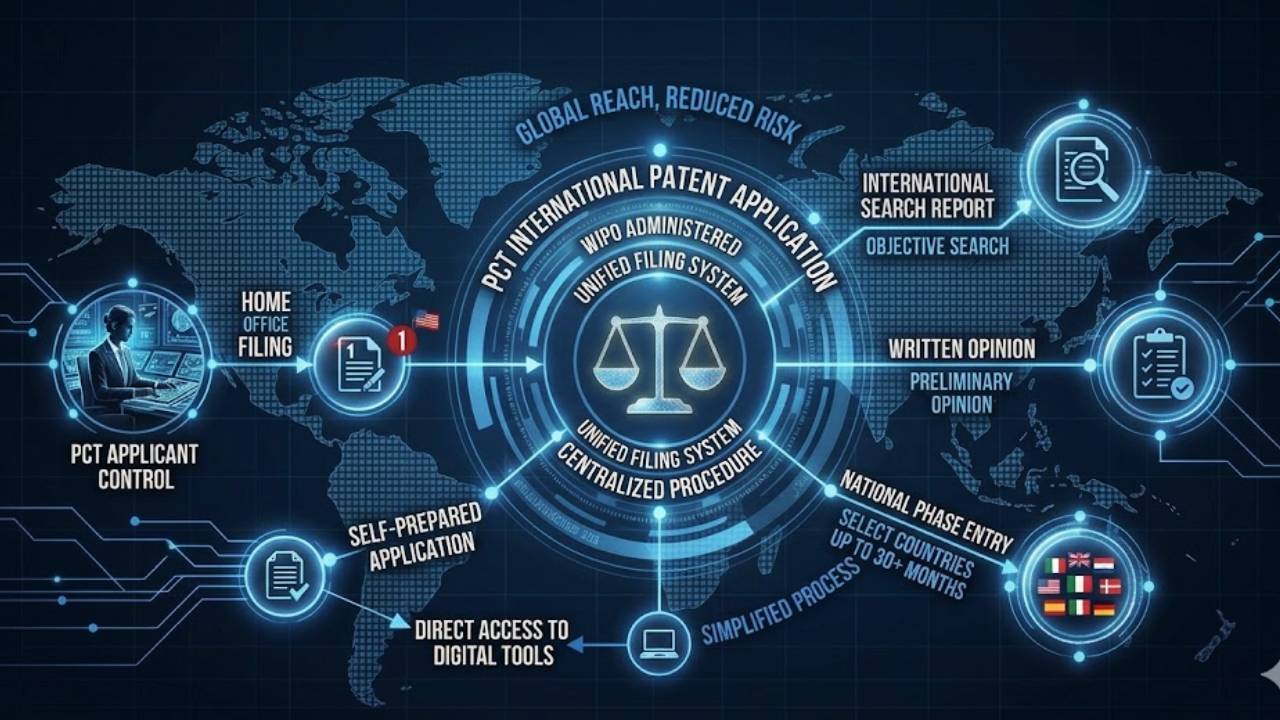
A PCT international patent application offers a unified route for inventors seeking protection across multiple countries without filing separate applications at the outset. It forms part of the global patent system governed by the World Intellectual Property Organization. Instead of submitting individual applications in each jurisdiction, applicants file a single international application which preserves their right to seek patents in numerous countries at a later stage.
For innovators, start-ups, and multinational businesses, understanding how this system works is essential. It helps manage costs, extend timelines, and build a strategic approach to global intellectual property protection. This article explains the concept, procedure, legal framework, and practical value of a PCT international patent application in a clear and structured manner.
Understanding the Global Patent Filing System
Patents are territorial rights. Protection must be secured in each country where exclusivity is required. Filing separate applications across jurisdictions can be complex and costly. The Patent Cooperation Treaty simplifies this process by allowing applicants to begin with a single international filing.
The treaty currently includes more than 150 contracting states. It does not grant a global patent. Instead, it creates a coordinated procedure which delays the need for multiple national filings. This delay allows applicants to assess commercial potential, evaluate patentability, and secure funding before committing to national filings. The system reflects a balance between procedural efficiency and national sovereignty. Each country retains authority to grant or refuse patents based on domestic law.
PCT international patent application Explained
A PCT international patent application is a single application filed under the Patent Cooperation Treaty. It acts as a placeholder for patent protection in multiple countries. The application undergoes an international phase before entering national or regional phases in selected jurisdictions. The international phase includes filing, an international search, and publication. In some cases, applicants may request a preliminary examination to gain further insight into patentability.
Once the international phase concludes, the application must enter the national phase in each chosen country. At this stage, it becomes subject to domestic patent laws and examination procedures.
Key authorities involved in the process include:
- European Patent Office
- United States Patent and Trademark Office
- Indian Patent Office
Each authority reviews the application independently and determines whether to grant a patent.
Legal Framework Governing PCT Applications
The Patent Cooperation Treaty provides a uniform legal structure for international filings. It establishes standard procedures for filing, searching, and publication of patent applications. The World Intellectual Property Organization administers the treaty and ensures consistency across member states. It also provides access to international patent databases and procedural guidance.
Applicants can refer to official government resources for compliance requirements. For example, the Office of the Controller General of Patents, Designs and Trade Marks offers detailed procedural guidance for applicants entering the national phase in India. The treaty does not replace national patent laws. Instead, it complements them by providing a streamlined filing mechanism.
Key Stages of a PCT International Patent Application
The process unfolds in two main phases. Each phase plays a distinct role in determining the fate of the application. The international phase begins with filing the application. Applicants may file through their national patent office or directly with the international bureau. After filing, an International Searching Authority conducts a prior art search and issues a written opinion on patentability. The application is then published, usually after eighteen months from the priority date. This publication makes the invention publicly available while preserving the applicant’s rights.
Applicants may also request an international preliminary examination. This optional step provides a deeper analysis of patentability and helps refine claims before national phase entry. The national phase follows the international stage. During this phase, applicants pursue patent protection in individual countries. Each patent office conducts its own examination and applies local legal standards.
Advantages of Filing a PCT Application
The PCT system offers several practical and strategic advantages. It allows applicants to delay significant costs associated with multiple national filings. This delay provides time to evaluate commercial viability and market potential. The international search report offers valuable insight into prior art. It helps applicants assess the strength of their invention before investing in multiple jurisdictions.
Another key benefit involves procedural simplicity. Instead of filing separate applications in different languages and formats, applicants begin with a single standardised application. For businesses planning global expansion, the system supports coordinated intellectual property strategies. Engaging PCT international Patent Lawyers can further enhance efficiency by ensuring compliance with procedural requirements and aligning filings with commercial goals.
Limitations of the PCT System
Despite its advantages, the PCT system does not eliminate the need for national filings. Each country still conducts its own examination and may grant or refuse the patent independently. The process can also become expensive during the national phase. Translation costs, attorney fees, and official charges vary across jurisdictions. Applicants must also manage strict deadlines. Failure to enter the national phase within the prescribed time may result in loss of rights in selected countries. Therefore, while the PCT system simplifies initial filing, it requires careful planning and execution at later stages.
Role of International Authorities
International authorities play a central role in the PCT process. These include the International Searching Authority and the International Preliminary Examining Authority. The International Searching Authority conducts a comprehensive search of prior art and issues a written opinion. This opinion evaluates novelty, inventive step, and industrial applicability. The International Preliminary Examining Authority provides a more detailed analysis when requested by the applicant. This examination helps refine claims and improve chances of success during national phase examination. These authorities operate under standards set by the World Intellectual Property Organization. Their findings guide applicants but do not bind national patent offices.
Strategic Importance for Businesses and Innovators
A PCT international patent application plays a crucial role in modern innovation strategy. It allows businesses to secure early protection while maintaining flexibility in choosing markets. Start-ups often use the system to attract investment. A pending international application signals technological innovation and commercial potential. Investors view such filings as indicators of long term value. Large corporations rely on the system to manage global portfolios. It supports coordinated filings across multiple jurisdictions while reducing administrative complexity. Legal guidance becomes essential in this context. Experienced International IP Lawyers can help applicants navigate jurisdictional differences, manage deadlines, and optimise patent strategies across global markets.
Importance of Government and Official Resources
Reliable information remains critical for successful patent filing. Government websites provide authoritative guidance on procedures, forms, and compliance requirements. Applicants should consult official portals for updates on filing rules and deadlines. For instance, the Indian Patent Office provides comprehensive resources for applicants filing or entering the national phase in India. Similarly, the United States Patent and Trademark Office offers detailed guidance on international applications and examination procedures in the United States. Using official resources enhances accuracy and ensures compliance with legal requirements.
Common Misconceptions About PCT Applications
Many applicants believe a PCT application grants a global patent. This is incorrect. The system only facilitates international filing. Actual patent rights arise only after national or regional grants. Another misconception involves cost savings. While the system delays expenses, it does not eliminate them. National phase filings still require significant investment. Some applicants also assume the international search guarantees patentability. In reality, national patent offices conduct independent examinations and may reach different conclusions. Understanding these limitations helps applicants make informed decisions and avoid procedural errors.
Future Outlook of the PCT System
The global innovation landscape continues to evolve rapidly. Emerging technologies such as artificial intelligence, biotechnology, and clean energy are driving demand for international patent protection. The PCT system is adapting to these changes through digital tools and improved data sharing. Electronic filing systems and online databases enhance accessibility and efficiency for applicants worldwide. As cross border collaboration increases, the importance of a streamlined international filing system will continue to grow. The PCT framework is likely to remain a cornerstone of global intellectual property protection.
Conclusion
A PCT international patent application serves as a powerful tool for securing global intellectual property rights through a unified filing process. It simplifies early stage procedures, extends decision timelines, and supports strategic planning across multiple jurisdictions. However, success depends on careful management of deadlines, compliance with legal requirements, and informed selection of target markets. By combining international procedural advantages with strong national strategies, applicants can effectively protect innovations and build long term competitive value in the global marketplace.
FREQUENTLY ASKED QUESTIONS (FAQS)
What is a PCT international patent application?
It is a single patent application filed under the Patent Cooperation Treaty which allows applicants to seek protection in multiple countries through a unified procedure.
Does a PCT application grant a global patent?
No. It only provides a streamlined filing process. Patents are granted separately by national or regional offices.
What is the timeline for a PCT application?
The international phase typically lasts up to thirty months from the priority date. After this period, applicants must enter the national phase in selected countries.
Is international preliminary examination mandatory?
No. It is optional but useful for assessing patentability and refining claims before national phase entry.
Can startups benefit from the PCT system?
Yes. It allows startups to delay costs, attract investors, and plan international expansion strategically.