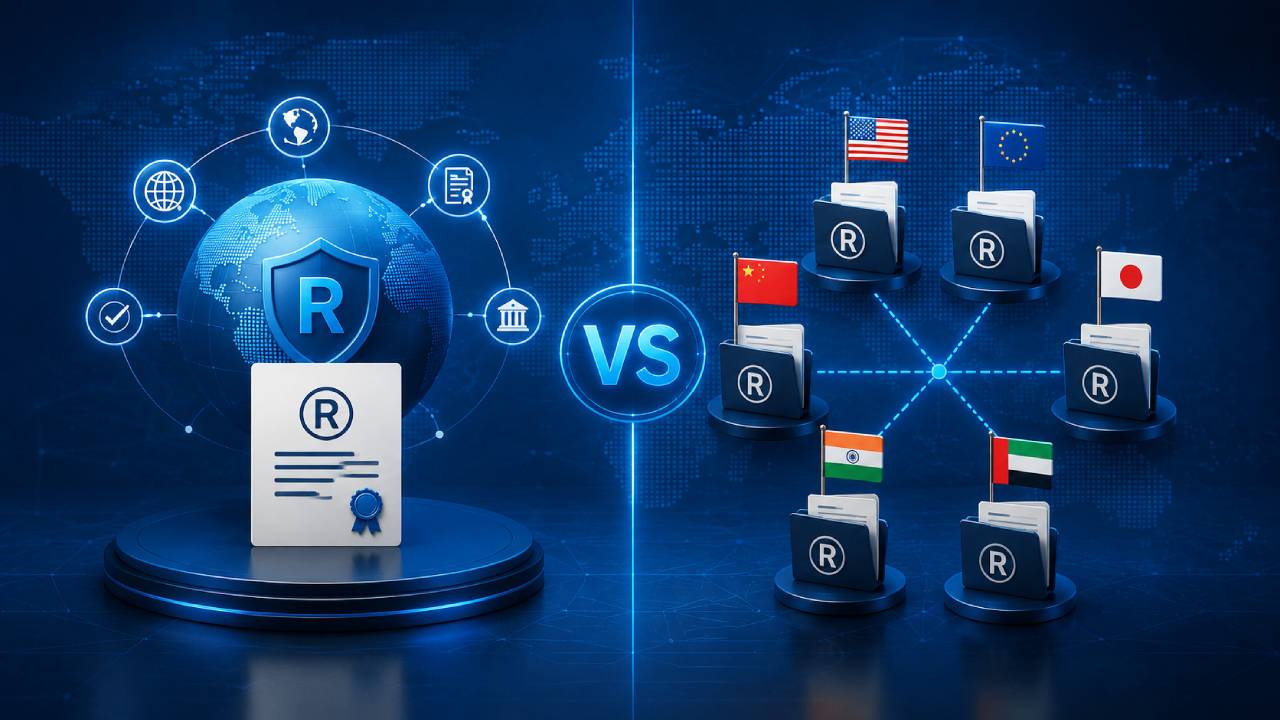
Expanding a business into international markets brings exciting opportunities, but it also creates new intellectual property challenges. One of the most important decisions businesses face is choosing the right method for protecting their trade marks overseas. Understanding Madrid Protocol vs Direct National Filing helps businesses select an approach that matches their commercial objectives, budget, and expansion plans. While both options provide access to trade mark protection in foreign jurisdictions, they differ significantly in terms of filing procedures, costs, flexibility, and long term management. Selecting the appropriate route at the beginning can reduce legal risks and simplify future brand protection.
International trade continues to grow rapidly, making trade mark protection more valuable than ever before. A registered trade mark prevents competitors from exploiting brand reputation and strengthens consumer confidence across multiple markets. Businesses entering foreign jurisdictions should understand both filing routes before investing in global expansion.
Understanding International Trademark Protection
Trade mark rights are territorial. A registration obtained in India protects a brand only within India unless separate protection is obtained in other countries. Businesses seeking overseas protection generally have two options. They may file a single international application under the Madrid Protocol or submit individual trade mark applications directly before each national intellectual property office. Both systems ultimately aim to secure trade mark rights. However, their procedures, timelines, costs, and legal implications differ considerably. Businesses should first identify their target countries, expansion strategy, expected growth, and available budget before choosing the most suitable filing route. For official information regarding international trade mark procedures, businesses may refer to the World Intellectual Property Organization (WIPO) and the Controller General of Patents, Designs and Trade Marks (CGPDTM), which provide comprehensive guidance on international filings.
What Is the Madrid Protocol?
The Madrid Protocol is an international treaty administered by the World Intellectual Property Organization. It enables trade mark owners to seek protection in multiple member countries through one international application. Instead of filing separate applications in every jurisdiction, applicants file through their home intellectual property office. Once the application is certified, WIPO examines formal requirements before forwarding it to each designated member country. Every designated country then conducts its own substantive examination according to local trade mark laws. Although the filing process begins centrally, each country independently decides whether protection should be granted. More than one hundred countries now participate in the Madrid System, making it one of the most widely used international trade mark filing mechanisms. Official information regarding the Madrid System is available through the World Intellectual Property Organization.
What Is Direct National Trademark Filing?
Direct national filing refers to submitting individual trade mark applications directly before the intellectual property office of each country where protection is required. Each application follows local procedural requirements, examination standards, classification rules, language requirements, and payment systems. Applicants usually appoint local trade mark attorneys or authorised agents within each jurisdiction. Unlike the Madrid System, each national application remains completely independent from every other application. Although this process involves greater administrative effort, it often provides additional flexibility for businesses entering selected markets.
Madrid Protocol vs Direct National Filing
Choosing between these two systems depends on several commercial and legal considerations rather than a single universal answer.
1. Filing Procedure
Under the Madrid Protocol, businesses submit one international application through their home intellectual property office. Direct national filing requires separate applications before every national office. Businesses expanding into numerous countries often appreciate the simplified administrative process offered by the Madrid route.
2. Cost Considerations
The Madrid Protocol generally reduces initial filing costs when protection is required across multiple member countries. Applicants pay one basic fee together with individual designation fees for selected countries. Direct filing usually involves separate government fees, translation costs, local attorney fees, and administrative expenses for every jurisdiction. However, businesses seeking protection in only two or three countries may sometimes find direct filing equally economical depending on national fee structures. Government fee information is available through national intellectual property offices, including the Indian Trade Marks Registry.
3. Administrative Convenience
One major advantage of the Madrid System is centralised management. Applicants may record renewals, ownership changes, address updates, and certain amendments through one international registration. Direct filings require individual management before each national office. For companies managing extensive global portfolios, central administration can significantly reduce long term administrative burden.
4. Flexibility
Direct filing offers greater procedural flexibility. Each application proceeds independently according to local requirements. Applicants may adapt specifications, amend descriptions, respond differently to examination reports, or pursue distinct legal strategies in each country. The Madrid System offers less procedural flexibility because several administrative actions remain linked to the international registration.
5. Dependency on the Basic Application
One important feature of the Madrid System deserves careful consideration. During the first five years, the international registration remains dependent upon the original home application or registration. If the basic application is cancelled, refused, or successfully challenged during this dependency period, the international registration may also become vulnerable. This principle is commonly referred to as central attack. Direct national applications remain entirely independent and therefore avoid this particular risk.
6. Examination Process
Both filing methods ultimately undergo examination under local trade mark legislation. A Madrid designation does not guarantee automatic registration. Each designated country examines the application according to its own laws relating to distinctiveness, prior rights, prohibited marks, and procedural compliance. Similarly, direct national applications undergo identical examination standards before the relevant national office. Therefore, the likelihood of registration primarily depends upon compliance with local trade mark law rather than the filing route selected.
Advantages of the Madrid Protocol
Businesses pursuing expansion across several member countries often prefer the Madrid System because it simplifies international filing.
Key benefits include:
- One international application.
- One language for filing.
- Central fee payment.
- Easier portfolio management.
- Central renewal process.
- Ability to add additional member countries later through subsequent designation.
These advantages make the Madrid System particularly attractive for growing businesses with ambitious international expansion plans.
Businesses planning broader overseas protection often consider Madrid Protocol Filing as an efficient way to simplify international trade mark administration while reducing procedural complexity.
Advantages of Direct National Filing
Despite its additional administrative requirements, direct filing remains highly valuable in many situations.
It offers:
- Independent national rights.
- Greater procedural flexibility.
- Reduced impact from central attack.
- Easier adaptation to local legal requirements.
- Suitable protection in countries outside the Madrid System.
Businesses targeting only a limited number of jurisdictions often prefer this approach because it allows customised filing strategies based upon local commercial needs.
Which Businesses Should Choose the Madrid Protocol?
The Madrid Protocol may suit businesses planning simultaneous expansion across numerous member countries.
It often benefits:
- Export businesses.
- Technology companies.
- Consumer goods manufacturers.
- Pharmaceutical companies.
- Fashion brands.
- Software businesses.
- Franchise operators.
- Companies with growing international portfolios.
Businesses expecting future expansion into additional Madrid member countries may also benefit from the ability to extend protection through subsequent designations without filing completely new international applications.
Which Businesses Should Consider Direct National Filing?
Direct filing may be more suitable where businesses:
- Need protection in only one or two countries.
- Require highly customised filing strategies.
- Expect objections requiring local legal arguments.
- Seek protection in non Madrid countries.
- Wish to avoid dependency upon the basic registration.
Certain industries with complex branding strategies also favour direct filing because local counsel can tailor applications according to national practice.
Businesses expanding gradually into selected foreign markets often find International trade mark registration through carefully planned national applications provides greater strategic flexibility for long term portfolio development.
Common Factors to Consider Before Choosing
Every international filing strategy should begin with a careful commercial assessment rather than simply selecting the cheapest option.
Important considerations include:
- Number of target countries.
- Whether those countries are Madrid members.
- Expansion timeline.
- Available budget.
- Long term portfolio management.
- Local legal requirements.
- Risk of objections.
- Strength of the home registration.
- Business growth plans.
Professional trade mark advice helps businesses balance legal protection with commercial priorities before filing internationally.
Can Both Filing Methods Be Used Together?
Yes.
Many multinational businesses combine both filing systems.
For example, they may use the Madrid Protocol for member countries while filing directly in jurisdictions outside the Madrid System.
Others initially file nationally in major commercial markets before using Madrid for broader expansion later.
This blended strategy often provides the greatest commercial flexibility while ensuring comprehensive international protection.
Conclusion
The debate surrounding Madrid Protocol vs Direct National Filing does not produce one universal answer because every business has different commercial objectives. The Madrid Protocol offers administrative efficiency, simplified portfolio management, and cost savings for businesses expanding across numerous member countries. Direct national filing provides greater flexibility, independent national rights, and customised legal strategies for selected jurisdictions.The most effective international trade mark strategy depends upon expansion plans, target markets, available resources, and long term brand management objectives. Careful planning before filing helps businesses avoid unnecessary costs while securing valuable intellectual property rights across global markets. Businesses should also monitor official guidance issued by the World Intellectual Property Organization and national intellectual property offices to remain informed about procedural requirements, fee updates, and international filing developments.
FREQUENTLY ASKED QUESTIONS (FAQS)
Is the Madrid Protocol better than direct national filing?
Neither option is universally better. The appropriate choice depends on the number of countries involved, budget, commercial objectives, and long term business strategy.
What is the main difference between Madrid Protocol and direct national filing?
The Madrid Protocol allows one international application covering multiple member countries, while direct national filing requires separate applications in each country.
Is the Madrid Protocol cheaper?
It can be more cost effective when protection is required across several Madrid member countries. For only a few jurisdictions, direct filing may offer comparable costs.
Can I use the Madrid Protocol for every country?
No. Only countries that are members of the Madrid Protocol can be designated through the system.